
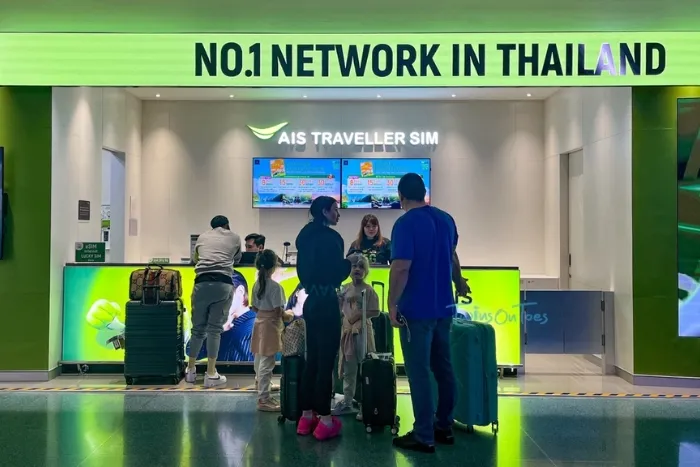
The simplest Thailand SIM card and money exchange plan is this: buy a tourist SIM or eSIM with your passport at an official AIS, True, or dtac counter in the arrivals hall (expect roughly 449 to 499 baht for 8 days of unlimited data), then get Thai baht from an ATM or an authorised exchange booth after comparing rates.
Withdraw larger amounts to limit the flat ATM fee, which is commonly 220 baht but can reach 350. Decline any offer to be charged in your home currency, and keep some cash for street food and taxis.
This guide walks you through both jobs step by step: how to choose, buy, and register a SIM, and how to get, exchange, and carry baht without overpaying.
Sort your phone and your baht before you land
- SIM: bring a passport and an unlocked phone; every Thai SIM must be registered to your passport
- Where to buy: official AIS, True, and dtac counters at the airport, or True dtac shops nationwide
- Limits: up to three SIMs per person per operator, and tourist SIM validity cannot exceed 60 days
- Cash: Thailand is still cash-first for street food, markets, and taxis
- ATMs: a flat fee applies to foreign cards, so withdraw bigger amounts less often and always choose baht
- Exchange: compare the board rates at banks and authorised changers, and avoid hotels
- Carrying cash: declare foreign currency over US$20,000 when entering or leaving
Part 1: How to get a Thailand SIM card as a tourist
Staying connected in Thailand is easy, but the registration rules tightened in 2025 and again in May 2026. That means you will spend a few minutes at the counter with your passport, whichever option you choose.
1. Choose your connection type
There are three main ways to get data in Thailand.
- Local tourist SIM: a physical SIM from AIS, True, or dtac with a Thai phone number. True lists its Infinite tourist SIMs for 8, 15, and 30 days, plus a 10-day data-only option, on its tourist SIM page.
- Local tourist eSIM: the same operators sell eSIM versions, so you can set up without swapping SIM cards. Thailand requires all SIMs, including eSIMs, to be registered to a passport.
- Travel eSIM from an international seller: bought online before you fly and usually data-only. True’s tourist page lists several partner resellers.
If you want a Thai number for calls, ride-hailing accounts, or deliveries, choose a local SIM or eSIM. If you only need data and want to skip the counter, a travel eSIM is the simpler route.
2. Check that your phone works
Your phone must be unlocked and support Thai network bands. True states that its tourist SIM works with 5G, 4G, or 3G devices on its designated frequencies. If you plan to use an eSIM, confirm that your phone model supports it before you travel.
3. Compare plans and prices
Prices change by channel and date, so treat these as a guide and confirm the amount at the counter.
- 8 days: True lists its Infinite SIM at 449 baht. Traveller guides citing AIS and True pages show 499 baht.
- 15 days: around 699 baht for unlimited data
- 30 days: around 1,199 baht for unlimited data
- Data-only: True sells a 10-day data-only SIM, with outgoing calls and texts disabled
- 60 days: AIS sells a longer plan, and 60 days is the maximum validity for any tourist SIM
Because longer plans cost proportionally less per day, buy a plan that covers your whole trip instead of topping up repeatedly.
Which network? Opensignal’s August 2026 report found that AIS is the most awarded operator, including for coverage and consistent quality, while the combined True and dtac network won Best Network for reliability and download speed. In practice, AIS is likely the safer pick if your route includes remote islands, national parks, or the countryside, and True or dtac is a strong choice for city-focused trips. Check each operator’s coverage map for your exact destinations before you buy.
4. Buy at an official counter with your passport
True and dtac tourist SIMs are sold at shops nationwide and at 24-hour airport counters. AIS has counters at the main international airports too. Staff will register your passport and activate the SIM for you.
Identity checks have tightened. A May 2026 notification requires registration in person at a branch or authorised dealer, and some counters add a liveness check, usually facial recognition. Buying from an unofficial street seller is not worth the risk.
5. Know the registration rules
The Thai telecom regulator (NBTC) rules are worth knowing, because they affect how you use your SIM.
- Passport registration: True’s terms say the SIM must be registered with a valid passport in line with NBTC rules.
- Three-SIM cap: non-Thai nationals are limited to three SIM cards per person per provider.
- 60-day activation: a registered SIM must be activated within 60 days, or you must re-verify in person.
- No extending after expiry: tourist SIM validity cannot be extended by topping up once it expires.
Pro Tip: Take a photo of your SIM packaging. It prints the codes you need to check your balance and manage your package, and you will want them when the data runs low.
6. Check your balance and top up
True’s FAQ says you can check your balance and validity by dialling *123#. Top-ups are available at True shops, 7-Eleven, and other selected points. If you need help, True’s call centre is 1242 and dtac’s is 1678.
Part 2: How to exchange money in Thailand
Once you are connected, the next job is getting Thai baht. You have three realistic options: withdraw cash from an ATM, exchange cash at a bank or booth, or pay by card where accepted.
1. Decide how much cash you need
Cards work in hotels, malls, and many restaurants. But street food, taxis, markets, and temple entry are often cash-only, so carry enough baht for your first day and top up as you go.
What about QR payments? Thailand’s QR payment network is expanding for visitors, but it depends on where you are from. TAT says cross-border QR payment lets you scan and pay at participating outlets using your home mobile banking app or e-wallet. It is currently available to users from China, Singapore, Malaysia, Indonesia, Vietnam, South Korea, Laos, Cambodia, and Hong Kong, with more markets planned. If you are from elsewhere, treat cards and cash as your main options. Cash is still dominant: a Bank of Thailand and Visa paper reported cash made up 78% of tourist spending by value in 2024, ahead of cards at 20%.
2. Withdraw baht from an ATM
For most travellers, an ATM is the easiest way to get baht. Just watch the costs.
- The Thai ATM fee: most machines charge a flat fee for foreign cards. Wise notes it is typically around 220 baht, but it varies. Some travellers now report 250 to 350 baht depending on the bank and card network. The fee is shown on the screen before you confirm, so read it.
- Withdraw more, less often: because the fee is fixed, small withdrawals are the least efficient. Limits are usually 20,000 to 30,000 baht per transaction, and your own bank may set a lower cap.
- Look for cheaper machines: AEON ATMs charge less for foreign cards and are found at stores such as Makro and Big C.
- Decline conversion: if the ATM offers to charge you in euros, dollars, or pounds, choose Thai baht. This is called dynamic currency conversion, and it usually gives you a worse rate.
- Check your home bank: foreign transaction fees and withdrawal limits vary, so confirm them before you travel.
3. Exchange cash at a bank or booth
If you carry foreign cash, exchange it in Thailand rather than at home, because you can generally find better baht rates locally. Here is how the options compare.
- Banks: World Travel Guide says banks offer good rates, while hotels charge high commissions.
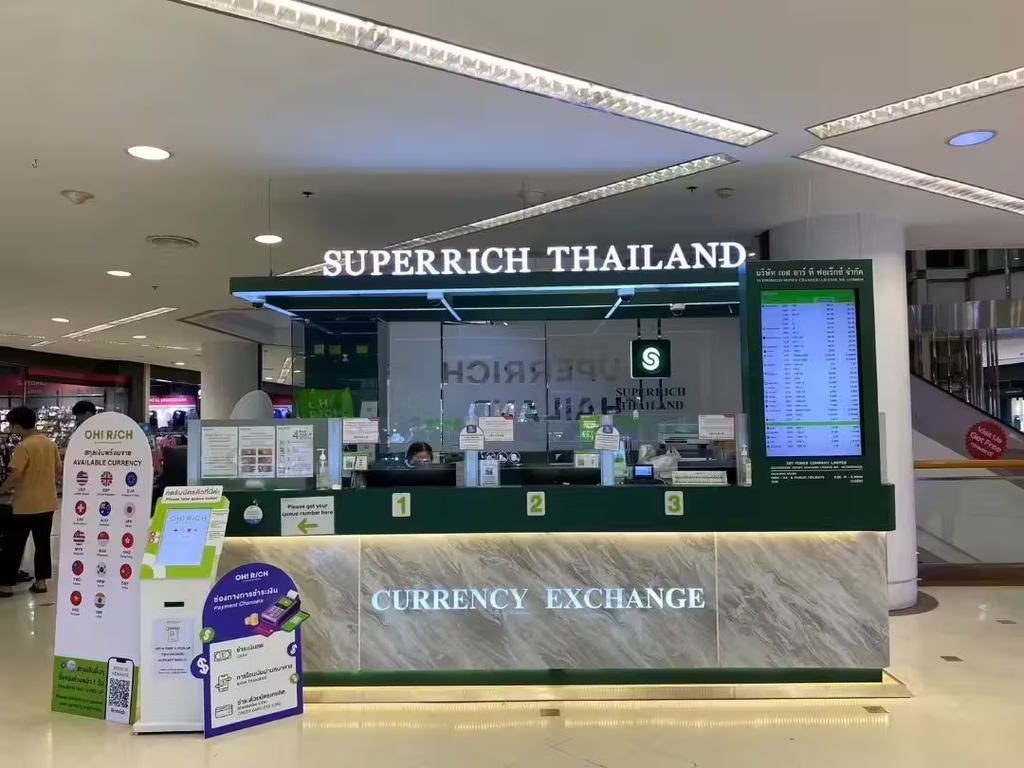
- Independent changers: booths such as SuperRich are often reported to offer better rates than banks, though there are fewer of them.
- Airports and hotels: convenient, but compare the rate board first, because the first counter you see may not be the best.
Always check the rate and any fee on the board, count your cash before you leave the window, and use only authorised changers.
Bring crisp notes. Exchange desks may refuse to change banknotes that are damaged or defaced, so bring clean, undamaged bills without tears, writing, or stamps. Experiences with folded notes vary, so keep your cash flat in a wallet or envelope. If a note is damaged, swap it at your home bank before you fly.
Pro Tip: Do not exchange everything at once. Change enough for a few days, then use an ATM or a better-rate booth in town once you know what you are spending.
4. Know the rules on carrying cash
There are a few limits to keep in mind, especially if you travel with a lot of cash or leave with leftover baht.
- Foreign currency: non-residents may bring in any amount, but you must declare more than US$20,000 (or equivalent) to customs when entering or leaving. Failing to declare is a criminal offence.
- Thai baht going out: non-residents may take out no more than 50,000 baht per person, with higher limits for neighbouring countries such as Laos, Cambodia, Myanmar, Malaysia, and Vietnam. Taking out more than 450,000 baht requires a customs declaration.
5. Protect your cards and cash
Card fraud is a known risk. The UK government advises that you do not lose sight of your card during transactions, protect your PIN, and use an ATM inside a bank where possible, as there have been incidents of ATM skimming. The Government of Canada also advises against leaving your card with bar or restaurant staff or running a tab.
A simple arrival-day order
- Clear immigration and collect your bags.
- Go to an official SIM counter, show your passport, and activate your SIM or eSIM.
- Use the new data to check your ride-hailing app or hotel directions.
- Withdraw a larger amount of baht from an ATM inside a bank or airport terminal, and decline conversion.
- Keep your passport, SIM packaging, and card receipts together.
FAQs about Thailand SIM card and money exchange
Do I need a passport to buy a Thailand SIM card?
Yes. Every Thai SIM must be registered with a valid passport under NBTC rules. This also applies to local eSIMs.
How much does a tourist SIM cost in Thailand?
Expect roughly 449 to 499 baht for 8 days of unlimited data, about 699 baht for 15 days, and about 1,199 baht for 30 days, according to True and AIS pricing reported by traveller guides. Prices change, so confirm at the counter.
Can I use an eSIM in Thailand?
Yes. Local operators and international sellers both offer eSIMs. Local eSIMs must still be registered to a passport.
How many SIM cards can a tourist register?
Non-Thai nationals can register a maximum of three SIM cards per person per provider.
Is it better to exchange money before or after arriving in Thailand?
Generally, you will find better baht rates in Thailand than at home. Bring a small amount of baht if your bank offers it, or plan to use an ATM on arrival.
How much can I withdraw from a Thai ATM?
Limits are usually 20,000 to 30,000 baht per transaction, depending on the bank. Your own bank’s daily limit may be lower.
Is there a limit on cash I can bring into Thailand?
There is no cap on foreign currency, but you must declare amounts over US$20,000 or the equivalent to customs.
Can I take leftover baht home?
Yes, up to 50,000 baht per person for most destinations. Exchange the rest before you leave or keep it for your next trip.
Can I pay by QR code as a tourist?
Only if your home payment app is supported. TAT lists China, Singapore, Malaysia, Indonesia, Vietnam, South Korea, Laos, Cambodia, and Hong Kong as the current markets, with more planned. Visitors from other countries should rely on cards and cash.
Official sources and references
SIM rules, plan prices, ATM fees, and exchange rates change often, so confirm the latest details with the sources below before you travel.
- True tourist SIM page: plans, terms, registration, and top-ups
- Tilleke & Gibbins analysis: the May 2026 NBTC SIM registration rules
- Opensignal Thailand report: August 2026 network awards
- Thai Embassy foreign currency notice: customs declaration rules
- US Commercial Service guide: Bank of Thailand currency limits
- TAT Pay Like a Local: cross-border QR payment markets
- Fintech News Singapore: Bank of Thailand and Visa tourist payment paper
- UK FCDO safety advice: card fraud and ATM skimming
- Government of Canada advice: card and ATM safety
- World Travel Guide: banks, hotels, and exchange
- Wise guide to Thai money: ATM fees, currency conversion, and note condition